Open any app and you’ll get nine different weight loss rules, most of them contradicting each other. That noise is exactly why so many people quit: they follow a myth, the scale doesn’t move, and they blame themselves instead of the advice. The fix is learning what your body genuinely does with food, fat, and energy — in other words, thinking biologically for weight loss. This article takes the nine most repeated myths in diet culture, puts each one next to the actual biology, and leaves you with a short list of what really works. No fads, no fear, just evidence explained in plain English.
Quick transparency: some links on this site are affiliate links that help fund our research at zero extra cost to you. We only recommend what we genuinely trust, and every myth below gets busted or confirmed by evidence, not by who pays.
Why Myths Are So Expensive for Your Progress
Myths don’t just waste time — they break expectations. If you believe metabolism dies at 30, you’ll quit before you start. If you believe a detox removes fat, you’ll watch the water weight drop, celebrate, then rebound. Every myth sets you up to misread what your body is doing, and misread signals lead to abandoned plans. Working biologically for weight loss means you stop judging your progress through broken lenses and start reading your body’s real signals.
Myth 1: “Calories In, Calories Out Is All That Matters”
The biology: Calories are real physics — you cannot lose fat without an energy deficit. But your body is not a calculator; it is a hormone-driven system that decides where calories go. The same 200 calories from soda or from lentils produce different insulin responses, different fullness signals, and different feeds for your gut bacteria. On top of that, metabolic adaptation is real: famous long-term studies of extreme dieters showed resting metabolism staying suppressed for years after the diet ended. The math matters, but biology writes the terms. That is why two people eating “the same” calories can get different results, and why calming storage hormones is as important as counting.
Myth 2: “Your Metabolism Crashes After 30”
The biology: A landmark 2021 study measuring energy expenditure across roughly 6,000 people, from infants to 95-year-olds, found that metabolism stays fairly stable from around age 20 to 60, then declines gradually. So the “it all slowed down at 30” story is mostly false. What actually changes is behavior and muscle: desk jobs cut daily movement, muscle quietly shrinks from the mid-30s without strength training, and sleep gets worse. Those three shifts lower your daily burn — and all three are fixable. Your metabolism is not broken; your lifestyle drifted. Protein, lifting, and steps bring the burn back.
Myth 3: “Fat-Burning Pills Melt Fat Away”
The biology: Fat leaves your body only when two steps run: fat cells release stored fat (lipolysis), and your muscles and organs burn it (oxidation). A capsule cannot run that cycle for you while you sit. Ingredients like caffeine or green tea extract may nudge the cycle slightly, and our roundup of the Best Supplements for Weight Loss covers exactly how small those effects are. But without a calorie gap and daily movement, “fat burners” burn almost nothing. Save the money for protein, walking shoes, and a gym bag — the boring tools that actually move the biology.
Myth 4: “Carbs at Night Turn Straight Into Fat”
The biology: When calories and protein are matched in controlled studies, meal timing changes results only slightly. The real damage of late eating is behavioral: tired people add extra, usually refined, calories at night, and heavy late meals can disrupt sleep — which then raises hunger hormones the next day. Your body clock is real, and insulin sensitivity does dip in the evening, but total intake and sleep quality carry far more weight than the clock. If a small evening snack fits your calories and your sleep stays solid, it will not sabotage you. If nighttime eating is where your cravings live, our guide on How to Manage Sugar Cravings Naturally tackles that directly.
Myth 5: “Cardio Is the Best Fat-Loss Tool”
The biology: Cardio is wonderful for your heart and lungs — and merely mid-tier for fat loss. After a workout, hunger hormones often rise and people quietly eat back what they burned; hard sessions can also make you move less the rest of the day. Meanwhile, research on everyday movement (NEAT) shows differences of hundreds of calories a day between people doing the same workouts. Strength training protects muscle, and muscle protects your resting burn. The strongest stack biologically for weight loss is: strength first, steps always, cardio for health.
Myth 6: “A Plateau Means It’s Not Working”
The biology: Fat loss was never linear. Water shifts can mask real fat loss for weeks — the reason some people suddenly drop a kilo overnight after a “stuck” month. At the same time, a smaller body needs fewer calories, so your original deficit slowly shrinks. Neither is failure; both are biology recalibrating. Judge progress by the 3–4 week trend, by measurements, and by how clothes fit — never by a single morning’s number. When a true plateau lasts over a month, recalculate your needs for your current weight and add steps or a strength session.
Myth 7: “Detox Teas and Cleanses Remove Fat”
The biology: Here is where fat actually goes when you lose it: in a published calculation, 10 kg of fat leaves the body as roughly 8.4 kg of carbon dioxide you exhale and about 1.6 kg of water. Your lungs are the real “detox” organ. Cleanses and teas drop water and gut content, so the scale dips for a few days — and the fat never moves. Your liver, kidneys, and lungs already handle detoxing for free, supported best by sleep, water, and protein. If bloating (not fat) is what bothers you, that is a different, gentler problem — see How to Manage Bloating Naturally.
Myth 8: “Genetics Make It Impossible for Me”
The biology: Genetics are real: heritability studies put body weight at roughly 40–70% inherited, and genes like FTO nudge appetite and food preference. But genes are a tendency, not a verdict. The same risk genes produce different bodies in different environments — the FTO effect shrinks noticeably in people who stay active. Your genes set the starting line and sometimes the headwind, but the biological levers in this guide — sleep, protein, strength, steps, stress — still move the outcome. Nobody chooses their genetics; everybody chooses the environment those genetics live in.
Myth 9: “You Must (or Must Never) Eat Breakfast”
The biology: Breakfast research shows no strong metabolic advantage in either direction. What matters is which pattern stabilizes your hunger and keeps your total food quality high. Some people do clearly better with a protein-rich breakfast because it quiets cravings all day; others do better with a shorter eating window and no morning meal. The myth is the universal rule. The biology is personal: test both patterns for two weeks each and keep the one that leaves your appetite calmer.
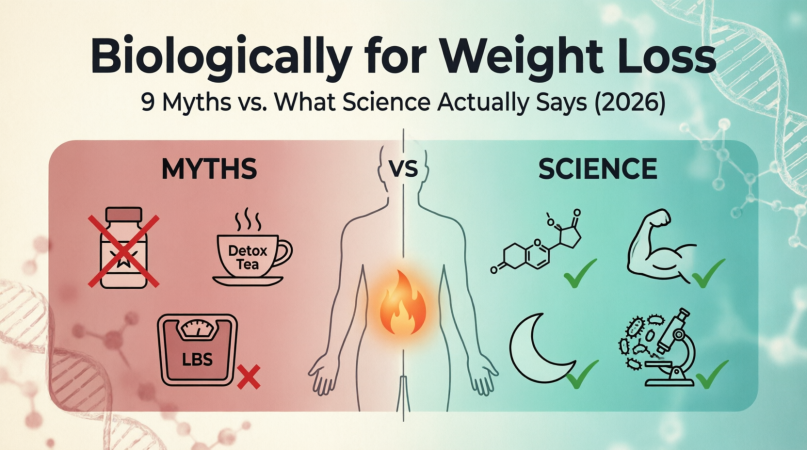
The 9 Myths at a Glance
| Myth | What biology actually says |
|---|---|
| Calories in vs. out is everything | Calories set the budget; hormones decide where it goes |
| Metabolism crashes after 30 | Stable from 20–60; muscle loss and less movement cause the drift |
| Fat-burning pills melt fat | Only the release-and-burn cycle removes fat; pills nudge at best |
| Night carbs turn to fat | Total intake and sleep quality matter more than clock time |
| Cardio is the best tool | Strength and everyday movement out-burn it across a week |
| A plateau means failure | Water shifts and adaptation mask loss; judge the 3–4 week trend |
| Detoxes remove fat | Fat leaves as CO2 through your lungs; cleanses drop water only |
| Genetics make it impossible | Genes are a tendency, not a verdict; environment changes the outcome |
| Breakfast rules are universal | The best pattern is the one that stabilizes your hunger |
What Actually Works Biologically for Weight Loss (The Short List)
Strip away the myths and the real list is short and boring — which is exactly why it works:
- A modest calorie gap (roughly 300–500 below maintenance), never a crash.
- Protein at every meal, to protect muscle and quiet hunger.
- Fiber from plants, to feed the gut bacteria linked to healthy appetite.
- Strength training 2–3 times a week, to defend your resting burn.
- More daily steps, the cheapest NEAT win available.
- 7–9 hours of sleep on a consistent wake time.
- Stress handled on purpose, so cortisol stays out of the driver’s seat.
For the full explanation of each lever, read our pillar guide, [INTERNAL LINK: How Your Body Burns Fat: The Full Biological Guide].
How to Run a 30-Day Myth-Free Self-Test
Change one thing per week so you can see what your body responds to. Week 1: fix sleep and add protein at breakfast. Week 2: add two strength sessions and 2,000 steps. Week 3: add a vegetable serving and a fermented food. Week 4: finish dinner three hours before bed. Weigh yourself three times a week and track the weekly average, not daily numbers. After 30 days you’ll have personal data instead of internet opinions — and personal data beats every myth on this page.
When a “Myth” Is Actually a Medical Issue
Sometimes the stall is not a myth or a mistake. Thyroid disorders, medications that promote weight gain, PCOS, insulin resistance, and sleep apnea can all blunt results even when you do everything right. If you’ve been consistent for 8–12 weeks with nothing moving, ask your doctor for proper lab work. It turns guesswork into a plan, and several of these conditions are very treatable.
One honest note before the FAQs: we’re health writers, not your personal doctor. Stubborn weight can sometimes trace back to thyroid issues, medications, PCOS, or sleep apnea — none of which respond to willpower alone. If you’ve been consistent for months with nothing moving, please bring it up with your healthcare provider. That conversation is part of the plan, not a last resort.
Frequently Asked Questions
Q: Is “calories in, calories out” wrong biologically for weight loss?
A: Not wrong, just incomplete. Calories decide whether energy is available, but hormones decide where that energy goes — stored or burned. The same 200 calories from soda or from lentils send very different signals to insulin, hunger, and gut bacteria. That’s why two people eating equal calories can get different results. Counting calories can help, but working biologically for weight loss means also calming the hormones that drive storage.
Q: Does metabolism really slow down after 30?
A: Mostly no. Large research on human energy expenditure found metabolism stays fairly stable from around age 20 to 60. The weight gain people blame on “slow metabolism after 30” usually comes from losing muscle, moving less, and sleeping worse. Strength training two to three times a week, daily walking, and enough protein protect the burn you already have. The decline after 60 is real but gradual.
Q: Can fat-burning supplements actually melt fat?
A: No supplement melts fat on its own. Fat only leaves when fat cells release it (lipolysis) and your muscles and organs burn it (oxidation). Ingredients like caffeine or green tea extract may nudge that cycle slightly, but without a calorie gap and daily movement, the effect is tiny. Think of supplements as a small push on a swing you still have to sit on.
Q: Do carbs eaten at night turn straight into fat?
A: Not automatically. Controlled studies show that when calories and protein match, meal timing changes results only slightly. The real problem with late eating is behavioral: tired people tend to add extra, usually refined, calories, and late meals can disrupt sleep, which then raises hunger hormones the next day. If a nighttime snack fits your calories and sleep stays solid, it won’t sabotage you.
Q: Why am I plateauing even though I eat less?
A: Plateaus are part of the biology, not proof of failure. As you lose weight, a smaller body needs fewer calories, and your daily burn quietly adapts downward. Water also shifts and can mask fat loss for weeks. Recalculate your needs for your current weight, add steps or two strength sessions, and judge progress by the 3–4 week trend, not single days.
Q: Is cardio the best exercise biologically for weight loss?
A: Cardio is great for your heart, but it’s not the strongest fat-loss tool. A smaller body plus hungry hormones often erase the calories a workout burns. Strength training protects muscle, which keeps your resting burn high, and everyday movement (NEAT) usually burns more across a week than gym sessions do. The best mix biologically for weight loss is strength first, steps always, cardio for health.
Q: Can genetics make weight loss impossible?
A: Genetics load the starting point, they don’t write the ending. Genes like FTO nudge appetite and food preferences, and heritability studies put body weight at roughly 40–70% inherited. But the same genes produce different results in different activity and sleep environments. Biology is a tendency, not a verdict — people with “strong” genetics still lose fat when the biological levers in this guide stay consistent.
The Bottom Line
Almost everything diet culture repeats is either incomplete or backwards. Your metabolism isn’t broken at 30, your genes aren’t a verdict, your lungs — not a tea — are where fat exits, and a plateau is biology recalibrating, not failing. Once you know what your body actually does, the path biologically for weight loss becomes refreshingly boring: modest deficit, protein, fiber, strength, steps, sleep, and patience. Pick one myth you’ve been believing, drop it this week, and replace it with one lever from the short list. That single swap is worth more than any miracle promise.
Nothing on this page is meant to diagnose, treat, or cure any disease, and the biology discussed here hasn’t been evaluated by the FDA as medical advice. It’s plain-English education — your doctor and your lab work always get the final say.